

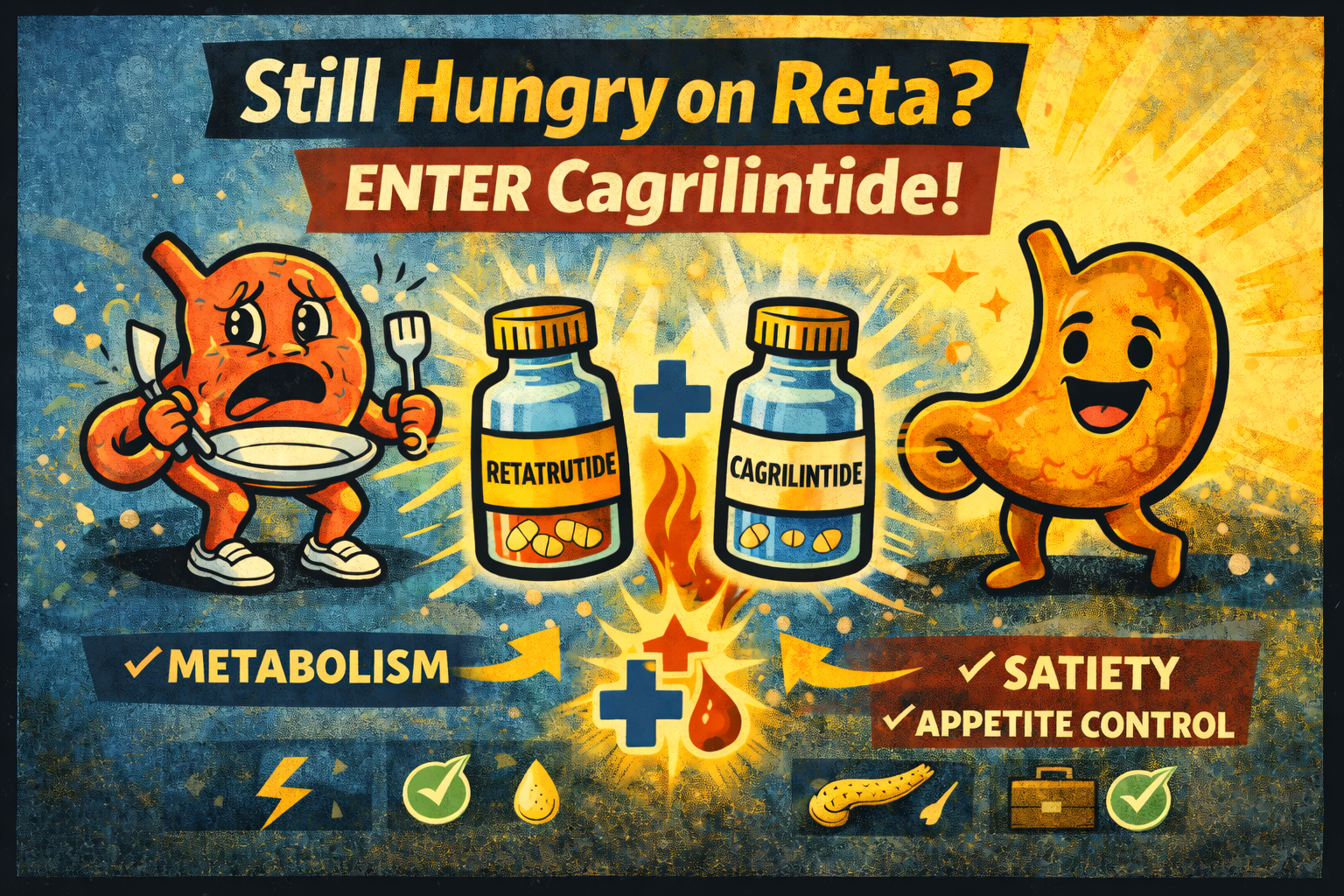
Still Hungry on Reta? Enter Cagrilintide
Retatrutide's Strength and Its Single Weakness
Retatrutide is considered the most powerful metabolic compound being studied today. Its impact on fat loss, insulin sensitivity, and cardiometabolic health surpasses every GLP-1 on the market. But here's what most people don't realize: Retatrutide's appetite suppression is actually weaker than semaglutide or tirzepatide.
Yes, Reta dominates in metabolic power, but it's lighter when it comes to hunger control. Some researchers note that users experience mild hunger throughout the day, evening cravings or food noise, and less fullness compared to semaglutide or tirzepatide. This is where cagrilintide steps in as the missing piece that turns Reta into a true 4-action mechanism.
How Retatrutide and Cagrilintide Complement Each Other
Retatrutide activates GLP-1, GIP, and glucagon receptors, giving it three powerful metabolic actions: GLP-1 improves insulin sensitivity and appetite regulation, GIP enhances fat metabolism and energy efficiency, and glucagon boosts energy expenditure and fat oxidation. These create unmatched metabolic and glycemic improvements but leave one opportunity for a fourth action.
Cagrilintide, an amylin analog, fills that gap by strengthening satiety, reducing food reward, and stabilizing appetite signals. When paired together, they form a 4-action system that tackles metabolism, energy, insulin, and appetite all at once.
Retatrutide drives energy expenditure, improves fat oxidation, boosts insulin sensitivity, and enhances metabolic flexibility, while cagrilintide deepens fullness, reduces cravings, cuts reward-based eating, and stabilizes daily appetite rhythm. When paired, the combo delivers complete appetite control, stronger and longer-lasting fullness, fewer cravings and less food noise, and enhanced fat loss and metabolic performance.
The Complete Package
Retatrutide fixes the metabolism while cagrilintide fixes the hunger, and together they create the most comprehensive appetite and metabolic system currently being studied. Reta handles metabolism, insulin, glucagon, and GIP synergy, while cagrilintide handles amylin-driven satiety and craving control.
The result is a true 4-action mechanism addressing metabolism, insulin regulation, energy expenditure, and appetite and reward control all in one stack. If Reta improves your metabolism but your hunger fluctuates throughout the day, cagrilintide may be the missing piece in completing the full pathway.
The distinction matters because most people assume appetite suppression comes automatically with metabolic improvement, but these are actually different pathways that work best when both are optimized simultaneously.
Disclaimer: For research and education only, not medical advice.